Every writer, at some point, faces the same quiet worry: is this truly my own work, or did someone else's words slip in unnoticed? Ideas travel fast, phrases get borrowed unconsciously, and in a world overflowing with content, originality has become harder to prove than ever. That's where the plagiarism checker steps in — not as a punishment machine, but as a quiet guardian standing between honest writing and accidental (or intentional) copying.
This article explores what a plagiarism checker really does, how it works behind the scenes, why it has become essential across education and publishing, and what its limits are.
What Is a Plagiarism Checker, Really?
A plagiarism checker is a software tool that scans a piece of writing and compares it against a massive database of existing content — websites, academic papers, books, and previously supplied documents—to find passages that are identical or strikingly similar. The objective is to preserve the integrity of ideas and provide credit where credit is due, not just to detect "copy-paste" cheating.
Modern plagiarism checkers go far beyond simple word matching. They're built to catch:
-
Direct copying — text lifted verbatim from another source
-
Light paraphrasing — sentences reworded just enough to avoid exact matches
-
Patchwriting — a blend of several sources stitched together without proper attribution
-
Self-plagiarism — reusing one's own previously published work without disclosure
How a Plagiarism Checker Actually Works
Text Fingerprinting
Most plagiarism detection systems break submitted text into small overlapping chunks — sometimes just a few words long — and generate a unique digital "fingerprint" for each chunk. These fingerprints are then compared against a vast index of existing content to spot matches, even when only fragments overlap.
Semantic and Contextual Analysis
Advanced checks use natural language processing to identify semantic similarity, or when two texts express the same idea and structure, even if simple word-matching misses artfully reworded plagiarism. the vocabulary has changed.
Cross-Referencing Massive Databases
The quality of a plagiarism detector depends on what it can compare to.Leading tools continuously crawl and index billions of web pages, academic journals, and previously submitted student papers, creating an ever-expanding library of comparison material.
Similarity Scoring
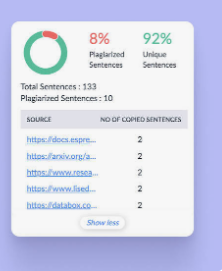
Rather than issuing a blunt "plagiarized" or "clean" label, most tools generate a similarity percentage, highlighting exactly which sentences or phrases matched existing sources, along with links to the original material. This gives the user context, not just a verdict.
Why Plagiarism Checkers Have Become Essential
Protecting Academic Integrity
Universities and schools rely heavily on 표절 검사기 to preserve the value of grades and degrees. Without them, distinguishing genuine scholarship from copied work at scale would be nearly impossible.
Safeguarding Original Journalism and Content
Publishers, bloggers, and content agencies use these tools to ensure the material they publish is genuinely original — both to maintain ethical standards and to avoid search engine penalties tied to duplicate content.
Supporting SEO and Search Visibility
Search engines actively deprioritize content that closely mirrors existing pages. Running content through a plagiarism checker before publishing helps writers and marketers protect their search rankings and avoid inadvertent duplication.
Defending Legal and Professional Reputations
In fields like law, research, and corporate communications, unintentional plagiarism can carry serious professional and even legal consequences. A 표절 검사기 acts as an early warning system before work goes public.
The Limitations Worth Understanding
Database Coverage Isn't Universal
No plagiarism checker has access to every piece of text ever written. Content behind paywalls, private documents, or sources outside its indexed database can slip through undetected, creating a false sense of security.
Common Phrases Can Trigger False Flags
Everyday expressions, technical terminology, and standard citation formats can sometimes register as "matches" even when no actual plagiarism occurred, requiring human judgment to interpret results properly.
It Can't Judge Intent
A plagiarism checker identifies textual similarity — it cannot determine whether the writer intended to deceive, forgot to cite a source, or simply used a common turn of phrase. That distinction still requires a human reviewer.
Sophisticated Paraphrasing Can Slip Through
Heavily reworded content, especially when run through paraphrasing software, can sometimes reduce similarity scores enough to bypass detection, even when the underlying ideas were clearly borrowed.
How to Get the Most Out of a Plagiarism Detector
-
In order to address problems before they worsen, run checks early in the writing process rather than just at the end.
-
Read the highlighted matches, not just the overall score — context often reveals whether a flag is meaningful or trivial.
-
Combine automated checks with proper citation habits, since no tool replaces disciplined sourcing.
-
Don't treat a low score as a guarantee of complete originality — always apply your own judgment alongside the report.
-
Choose a checker with a large, frequently updated database for the most reliable comparisons.
The Future of Plagiarism Detection
As content creation accelerates — fueled partly by generative AI — the plagiarism checker is evolving to keep pace:
-
AI-aware detection is emerging to distinguish between human paraphrasing and machine-generated rewording
-
Cross-language detection is improving, catching plagiarism that's been translated from one language into another
-
Real-time writing assistants are increasingly bundling plagiarism checks directly into word processors and content platforms
-
Deeper semantic models are making it harder for reworded or "spun" content to escape detection
Final Thoughts
A plagiarism checker isn't just a gatekeeper for catching wrongdoing — it's a tool for protecting something more fundamental: the value of original thought in a world where words move faster than before, and it's never been simpler to replicate. Used thoughtfully, it helps students learn honest research habits, helps writers trust their own originality, and helps readers trust that what they're reading hasn't simply been recycled from somewhere else.
No tool can fully replace human judgment and integrity. But as a first line of defense in an increasingly crowded information landscape, the plagiarism checker has earned its place as one of the quiet, essential safeguards of honest writing.
Read More Latest Articles: Clicking Here


Share this page with your family and friends.