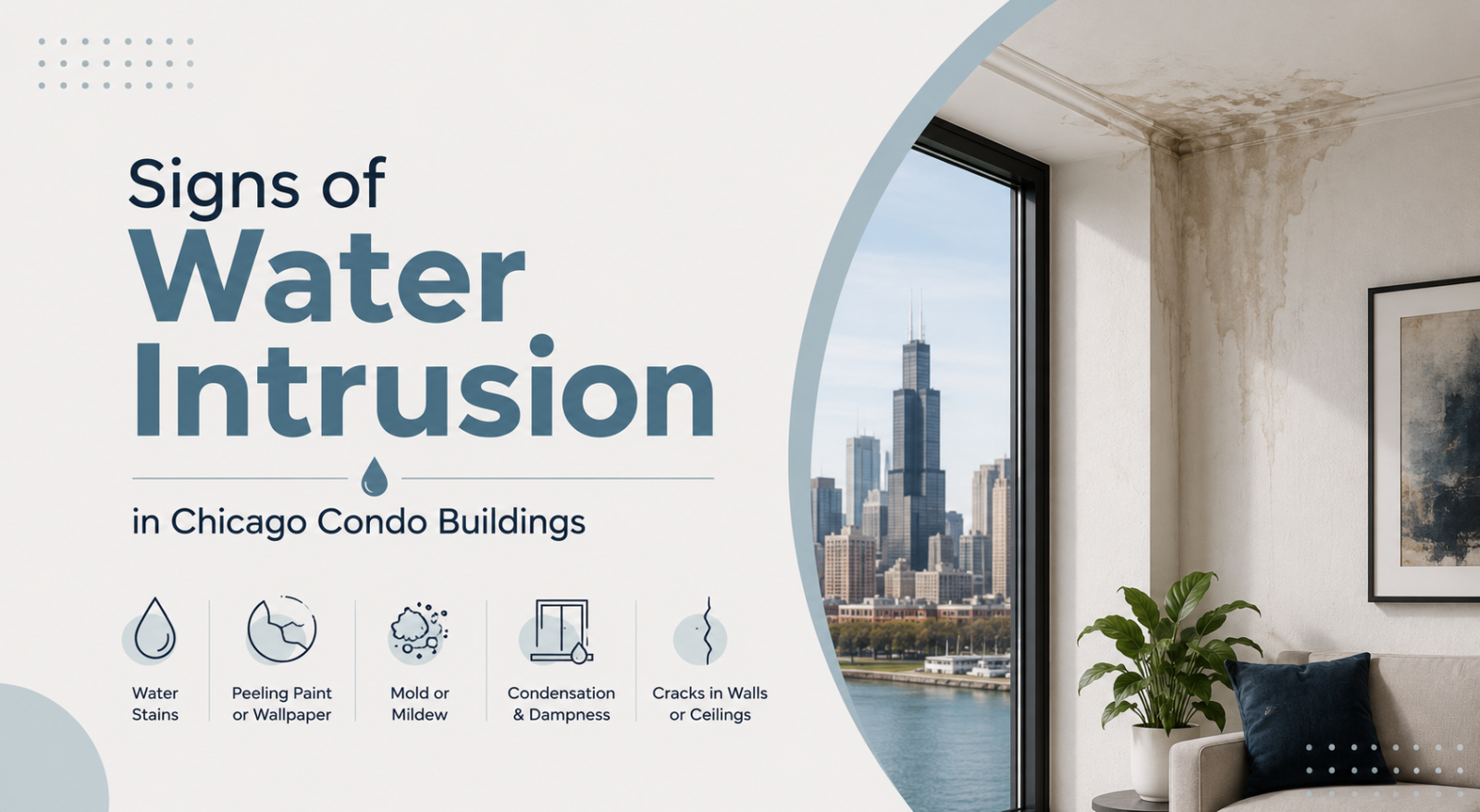
Water intrusion in Chicago condo buildings rarely shows up in obvious ways at first. Instead, it quietly works behind walls, ceilings, and flooring until the damage becomes expensive to ignore. During a condo inspection , these early warning signs can reveal how moisture is moving through the structure and whether a building is truly as solid as it looks.
9 Water Intrusion Red Flags in Chicago Condo Inspections
Water rarely announces itself with a dramatic leak. More often, it leaves behind subtle clues that quietly point to a much bigger problem.
1. Mysterious Stains That Seem to Appear Out of Nowhere
What appears to be a harmless looking spot on your ceilings could actually signify moisture making its way through the building envelope. Even if it appears to be an isolated case, these signs can actually signify an active leak and not one that occurred long ago.
This problem should be investigated properly to ascertain whether there is indeed a source of water coming into the building structure at present, even if only in small amounts. The stains could serve as pointers.
2. Paint That Refuses to Stay Put
It would be a good idea to consider the possibility that some areas in the property where paint seems to be deteriorating have been exposed to moisture. Moisture beneath the surface of paint tends to weaken the bonding between the wall and the paint.
These problems may persist despite several repainting efforts. It would help to investigate whether water is seeping through the exterior walls or roof materials and other sources within the structure.
3. A Musty Smell That Never Quite Goes Away
No amount of cleaning and airing out a room seems to help remove some smells. This particular musty odor is often indicative of the presence of moisture. The moisture may be stored in the walls or under the floor of the house, which will promote the growth of an undesirable entity.
The human nose can detect problems well before the eyes can see them. Whenever there are halls, storerooms, or units that have that distinct smell of dampness, it is important to investigate whether there might be any moisture buildup somewhere that cannot be seen.
4. Windows That Leave More Than Just Condensation Behind
Condensation is very typical for windows during the cold Chicago winters, but too much moisture accumulation around the windows should be taken into account. Moisture buildup around the windows may gradually seep into drywall, trimming, and insulation material.
Moisture problems may be easily ignored, especially in colder seasons. However, it is important to consider that inspectors tend to pay much attention to windows for this very reason.
5. Flooring That Starts Acting Strange
Flooring is one of the surprising surfaces that indicate any issues with moisture. You can find wood floor warping, raised edges of laminate floor, or even some irregularities on your floors. All of these factors happen as a result of moisture affecting those materials underneath. Any small defect may become large enough to affect the whole area.
6. Cracks That Keep Coming Back
Not all cracks necessarily indicate water damage, but recurring cracks should not be ignored. Moisture can deteriorate building materials, causing structural movement that allows cracks to appear again once they have been fixed. You might seal up these cracks multiple times only to find them coming back again a few months down the road.
Recurring cracks can be indicative of a larger moisture problem, especially when paired with other moisture damage symptoms. These cracks usually signal bigger problems than just a cosmetic issue.
7. Rust Appearing Where It Shouldn't
Building components made of metal shouldn’t develop rust for no apparent reason. In the case of pipes, supports, electrical panels, and mechanical systems, rust could be a sign that there’s moisture present in those areas. Corrosion tends to be one of the first clues that there is an accumulation of water.
Rust tends to be taken very seriously since it could indicate moisture damage to building systems. Even small spots of rust could turn into big problems in the future.
8. Exterior Materials Showing Signs of Wear
What goes on inside the building could actually be examined through the external structure. Broken down sealants, decaying masonry, detached siding, and even failing caulking can provide a way for water to gain entry into your structure.
This is one reason inspectors evaluate the entire structure rather than isolated areas. Similar observations are often made during a commercial property inspection , where building envelope performance plays a major role in assessing overall condition.
9. Mold Appearing in Unexpected Places
Mold requires water to grow. While obvious signs of mold are noticeable at once, even a small presence of mold indicates that there is water intrusion somewhere nearby. It’s only natural for bathrooms and kitchens to be humid environments, however, the appearance of mold in unusual places should trigger additional research.
Mold should be treated as a sign and not a cause itself. In other words, without resolving the cause of water intrusion, the mold problem may just resurface again in the future.
Conclusion
It’s easy to identify the signs of water intrusion early on. This can help you take care of any problems with your property at the earlier stages.




Share this page with your family and friends.