RWA tokenization is gaining attention across financial markets because blockchain-based representations of real-world assets can support new ways to issue, manage, transfer, and monitor investment interests. Private credit and real estate are two major asset categories being considered for tokenization, but they do not require the same platform structure. Their legal arrangements, investor profiles, cash flow patterns, data requirements, compliance procedures, and secondary market models differ considerably.
For businesses planning RWA tokenization platform development, understanding these differences is important before selecting the technology stack or designing the investor experience. A platform intended for private credit may need loan servicing, borrower monitoring, repayment schedules, and credit reporting functions. A real estate-focused platform may require property valuation data, ownership structures, rental income management, property documents, and asset-level reporting.
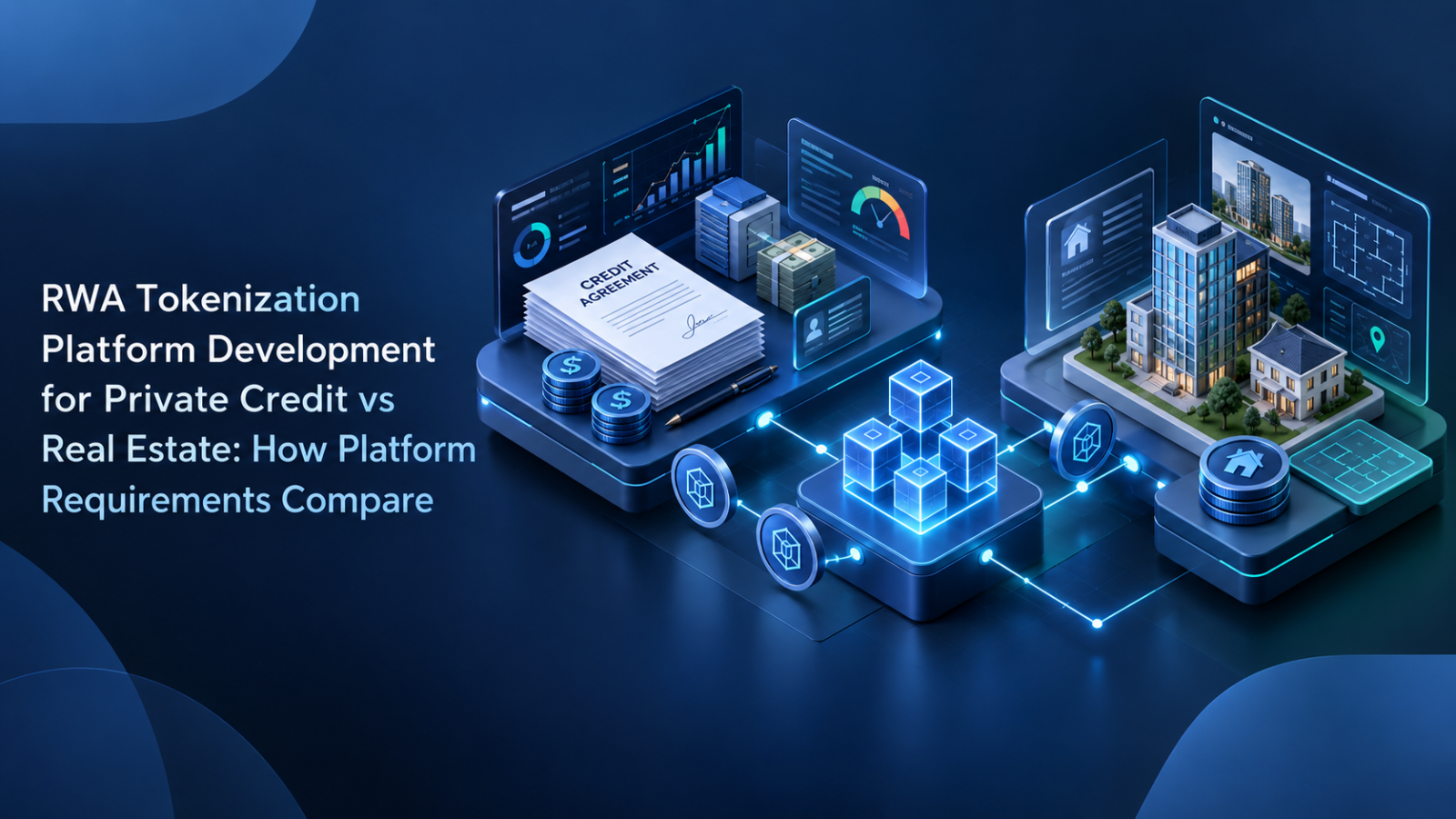
This article compares private credit and real estate tokenization from a platform development perspective and explains how businesses can approach each model.
Private Credit and Real Estate Tokenization: Where the Models Differ
Private credit generally involves loans, debt instruments, receivables, or other credit arrangements where investors receive returns based on interest payments, repayments, or contractual obligations. The platform therefore needs to represent financial obligations and monitor borrower activity.
Real estate tokenization usually represents an economic interest in a property, property-holding entity, fund, or portfolio. Investors may receive rental income, property appreciation proceeds, or distributions from an underlying real estate structure.
The difference affects almost every platform component. Private credit requires more attention to credit lifecycle management, while real estate requires deeper property and ownership administration.
Method: Define the Asset Structure First
A business working with private credit should define the loan or credit instrument, borrower relationship, maturity date, interest structure, repayment schedule, collateral information, and default conditions.
For real estate, the platform should define the property, ownership vehicle, investor rights, valuation process, income model, expenses, holding structure, and exit conditions.
This initial classification helps an RWA tokenization development team select appropriate smart contract logic and platform modules.
Platform Requirements for Private Credit Tokenization
Private credit platforms need to manage financial instruments rather than physical assets. The platform may represent individual loans, groups of loans, invoices, private debt instruments, or other credit exposures.
Investors may purchase tokens linked to a specific loan or a portfolio of credit assets. Their returns can depend on scheduled interest payments, principal repayments, refinancing, or recovery activity following a default.
Method: Create a Credit Instrument Management Layer
A private credit platform should maintain detailed records for every credit instrument. These records can include borrower information, principal amount, interest rate, maturity, payment dates, collateral details, risk classification, and outstanding balance.
Smart contracts can handle selected activities such as token issuance, transfer restrictions, payment calculations, and distribution rules. However, off-chain systems may still be required for underwriting, loan servicing, accounting, legal records, and credit assessment.
Method: Add Repayment and Distribution Logic
Private credit investors usually expect periodic income. The platform should therefore connect payment schedules with tokenholder records.
When a borrower makes a payment, the platform can calculate the portion associated with eligible tokenholders. Depending on the legal and operational model, distributions may occur through stablecoins, bank payments, or another approved settlement method.
Late payments and defaults also require specific handling. The system may need status changes, payment notifications, revised schedules, recovery records, and restrictions on certain actions.
Method: Include Credit Monitoring
Credit-focused platforms benefit from borrower monitoring and reporting functions. Data may include payment history, outstanding balances, covenant status, credit events, and portfolio performance.
A dashboard can present this information to administrators and eligible investors without exposing confidential borrower information to unauthorized users.
For a private credit project, an RWA tokenization company therefore needs to consider loan servicing and credit administration alongside blockchain functionality.
Platform Requirements for Real Estate Tokenization
Real estate tokenization introduces a different set of operational requirements. The platform may represent ownership or economic interests in residential properties, commercial buildings, hotels, industrial facilities, rental portfolios, or real estate funds.
Property documents, valuation reports, ownership structures, rental agreements, tax records, insurance information, and maintenance expenses may all become relevant to platform operations.
Method: Create Property-Level Asset Records
A real estate platform should maintain records for every property linked to a tokenized offering. These records may include property type, location, acquisition price, valuation, ownership entity, rental income, expenses, occupancy information, and relevant legal documents.
The platform can connect these records with token information so investors can understand which property or portfolio their holdings relate to.
Method: Manage Ownership and Investor Rights
Real estate tokenization often uses a legal entity that holds the property while tokens represent defined economic or ownership interests in that entity.
The platform must therefore connect investor balances with the rights described in the offering documents. These may include income distributions, voting rights, redemption conditions, transfer restrictions, or proceeds from a property sale.
Smart contracts can manage token balances and selected rights, while legal agreements remain necessary to define the relationship between the investor, issuer, and underlying property.
Method: Add Rental Income and Expense Management
Rental properties generate recurring income but also incur costs. Property management fees, insurance, taxes, repairs, utilities, and other expenses may affect investor distributions.
A real estate tokenization platform can record these transactions and calculate distributable income according to the relevant legal and financial structure.
This creates a different payment model from private credit. Instead of primarily tracking interest and principal, the platform may need to account for rental income, operating expenses, reserve funds, and sale proceeds.
Private Credit vs Real Estate: Technology Comparison
The technology foundation for both asset classes can share several components. These include blockchain infrastructure, smart contracts, investor accounts, identity verification, compliance controls, token management, wallets, transaction records, and administrative dashboards.
The difference lies in how these components are configured.
Private credit platforms generally require more financial servicing functions. Real estate platforms require more asset administration and property data management.
Method: Use Modular Platform Architecture
Businesses can create a common RWA tokenization platform development foundation and add asset-specific modules.
A shared layer can contain user registration, identity checks, wallet management, token issuance, permission controls, compliance rules, notifications, and reporting.
The private credit module can then add loan servicing, borrower records, repayment schedules, credit events, and portfolio analytics.
The real estate module can add property records, valuation updates, rental income, expenses, ownership structures, and property-level reporting.
This approach can reduce duplicated development work when a business plans to support multiple asset classes.
Smart Contract Design Differences
Smart contracts play an important role in both private credit and real estate tokenization, but their functions differ.
For private credit, smart contracts may manage token issuance, investor eligibility, payment allocation, transfer rules, maturity events, and repayment-related actions.
For real estate, smart contracts may manage ownership units, distribution calculations, investor voting, transfer restrictions, redemption conditions, and proceeds from asset sales.
Method: Define Rules Before Contract Development
A development team should first document the legal and financial rules that the contracts need to represent. This includes who can hold tokens, when transfers are permitted, how income is distributed, and what happens during major asset events.
The contract logic should then be reviewed through testing and security assessment before being used with real assets.
An RWA token development project should not begin with smart contract coding alone. The legal structure, financial model, and operating procedures need to be documented first.
Compliance Requirements for Both Asset Classes
Regulatory requirements can differ depending on the jurisdiction, asset type, investor category, offering structure, and token characteristics.
Both private credit and real estate platforms may require identity verification, investor eligibility checks, transaction monitoring, record keeping, and transfer restrictions.
Private credit may require additional controls related to borrower information and credit records. Real estate may require extensive property ownership and transaction documentation.
Method: Add Permission-Based Token Transfers
Permissioned transfers can restrict token movements to eligible participants. The platform can check investor status before allowing certain transactions.
A compliance engine can maintain information about investor verification, jurisdiction, accreditation or eligibility status where applicable, and holding limits.
The precise controls should be determined with qualified legal and compliance professionals for the target market.
Data and Oracle Requirements
External data can play an important role in both asset classes.
Private credit platforms may need repayment information, interest rates, borrower events, credit data, and payment confirmations.
Real estate platforms may require property valuations, rental income information, occupancy data, market information, and other asset-level records.
Method: Separate Verified External Data From Blockchain Records
Not every piece of information needs to be stored directly on-chain. Sensitive documents and large datasets can remain in controlled off-chain systems, while blockchain records can maintain references, transaction states, and relevant proofs.
Oracle or data integration services can bring selected external information into smart contract workflows when required.
This structure can also help reduce unnecessary blockchain storage costs.
Investor Experience: Private Credit vs Real Estate
Investor interfaces should reflect the way each asset class generates returns.
A private credit dashboard may show principal invested, interest rate, maturity date, repayment history, outstanding principal, payment status, and credit events.
A real estate dashboard may show property value, ownership percentage, rental income, occupancy, expenses, distributions, and portfolio composition.
Method: Design Dashboards Around Investor Decisions
Instead of presenting identical information for every asset class, the interface should prioritize the metrics investors actually need.
For private credit, payment status and maturity may receive greater attention.
For real estate, property performance, income distributions, valuations, and expenses may be more relevant.
The result is a platform that communicates asset performance according to its underlying financial model.
Secondary Market Considerations
Secondary trading is another area where private credit and real estate can differ.
Private credit tokens may face restrictions because buyers need to understand borrower exposure, maturity, payment history, and risk characteristics.
Real estate tokens may depend on property valuation, ownership structure, investor eligibility, and market demand.
Method: Add Controlled Transfer and Trading Functions
A platform can include an internal marketplace or connect with an external regulated trading venue where permitted.
Transfer eligibility checks should happen before a transaction is completed. Pricing information can be presented alongside relevant asset data, but the platform should not assume that token liquidity will automatically develop after issuance.
For both models, the legal rights represented by the token must match the rights available during secondary transactions.
Which Platform Is More Complex?
Neither private credit nor real estate is universally easier to tokenize. The complexity depends on the asset structure, jurisdiction, investor group, legal arrangement, and operating model.
Private credit may require deeper financial servicing and borrower monitoring. Real estate may require extensive property administration, legal documentation, valuation processes, and income management.
A business should therefore evaluate complexity based on the complete asset lifecycle rather than looking only at token creation.
Method: Map the Full Asset Lifecycle
For private credit, the lifecycle may run from underwriting and issuance to repayment, refinancing, default management, and maturity.
For real estate, it may run from acquisition and token issuance to property management, income distributions, valuation updates, refinancing, and eventual sale.
Mapping these stages helps a RWA tokenization development company identify the modules required for the platform.
Choosing the Right Development Approach
Businesses entering this market can work with an RWA tokenization development company to create a platform around one asset class first and later add additional modules.
An RWA tokenization platform development company can structure the system around shared functions such as compliance, investor management, wallets, token issuance, and reporting, while maintaining separate workflows for private credit and real estate.
For organizations seeking a faster market entry, licensing an existing platform may also be considered. Businesses seeking greater control over product logic may prefer a dedicated development project.
The decision should depend on budget, regulatory requirements, expected asset volume, target investors, operating model, and future asset categories.
Conclusion
Private credit and real estate can both support RWA tokenization, but their platform requirements are quite different. Private credit requires attention to borrower records, repayment schedules, interest calculations, credit monitoring, and financial servicing, while real estate requires property records, ownership structures, valuations, rental income, expenses, and property-level reporting. A well-planned RWA tokenization platform development strategy should account for these differences instead of treating every real-world asset in the same way. Businesses can use shared infrastructure for identity, compliance, wallets, token issuance, and investor management while adding asset-specific modules for credit or property workflows. The right structure can also leave room for future asset categories without forcing every product to follow the same operational model. Businesses working with an RWA tokenization company or real-world asset tokenization company should first define the legal structure, asset lifecycle, investor rights, data sources, compliance model, and distribution process before moving into technical development. Blockchain App Factory provides RWA tokenization development services for businesses planning platforms around private credit, real estate, and other real-world asset categories.
FAQs
1. What is RWA tokenization platform development?
RWA tokenization platform development involves creating a software platform that represents interests in real-world assets through blockchain-based tokens. The platform can include token issuance, investor management, compliance, wallets, asset records, distributions, and reporting.
2. Is private credit suitable for RWA tokenization?
Yes. Private credit can be represented through tokens linked to loans, debt instruments, receivables, or credit portfolios, subject to the applicable legal and regulatory structure.
3. How does real estate tokenization differ from private credit tokenization?
Real estate tokenization generally focuses on property ownership or economic interests, rental income, valuations, expenses, and property transactions. Private credit focuses more heavily on borrowers, repayments, interest, maturity, and credit events.
4. What functions should a private credit tokenization platform include?
Common functions include borrower records, loan management, repayment schedules, interest calculations, investor eligibility checks, token management, payment allocation, portfolio reporting, and credit event tracking.
5. What functions should a real estate tokenization platform include?
A real estate platform may include property records, ownership management, investor onboarding, token issuance, rental income tracking, expense management, valuation records, distributions, document management, and transfer controls.
6. What is the role of smart contracts in RWA token development?
Smart contracts can manage token issuance, balances, transfer rules, distribution calculations, investor permissions, voting processes, and other predefined actions. Their exact role depends on the legal and financial structure of the asset.
7. Can one RWA platform support both private credit and real estate?
Yes. A platform can use shared infrastructure for identity, compliance, wallets, token management, and investor accounts while adding separate modules for private credit and real estate operations.
8. How does an RWA tokenization company approach these two asset classes?
An RWA tokenization company typically begins by reviewing the asset structure, legal rights, investor model, compliance requirements, data sources, and asset lifecycle. The technical design can then be aligned with those requirements.
9. What is RWA token development?
RWA token development refers to creating blockchain tokens that represent defined rights or interests connected with real-world assets. The token design depends on the underlying asset and the legal arrangement supporting it.
10. Should businesses develop or license an RWA platform?
The decision depends on factors such as budget, desired control, regulatory requirements, launch timeline, asset types, and long-term product plans. A business should compare both approaches before selecting a development model.




Share this page with your family and friends.