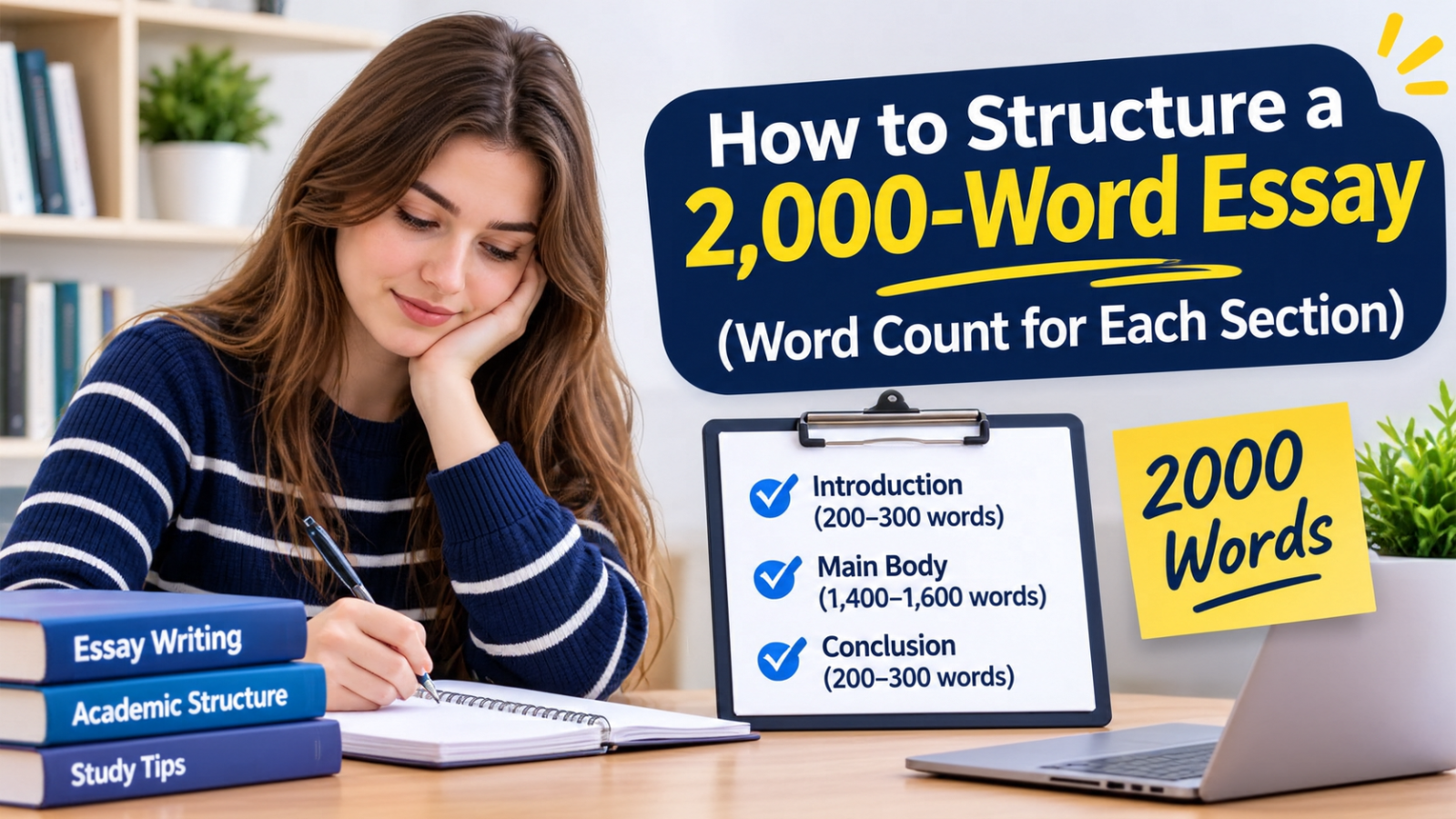
The standard 2000 word essay structure is a 200-word introduction (10%), a 1,600-word main body (80%) and a 200-word conclusion (10%). Split the body into four paragraphs of about 400 words, each making one point that answers the question. Your reference list usually doesn't count towards the 2,000 words, but in-text citations and quotations usually do.
This 10-80-10 split isn't an internet rule of thumb. It's what UK university study skills teams tell their own students. The University of West London, for example, advises that unless you're given specific word counts, each section should only be 10% of your word count (20% in total), with the remaining 80% for the main body.
2,000-Word Essay Word Count Breakdown
|
Section
|
Words
|
% of essay
|
Job it does
|
|
Introduction
|
200
|
10%
|
Context, your argument, roadmap
|
|
Body paragraph 1
|
400
|
20%
|
Strongest point with evidence
|
|
Body paragraph 2
|
400
|
20%
|
Second point, building on the first
|
|
Body paragraph 3
|
400
|
20%
|
Third point or the counter-argument
|
|
Body paragraph 4
|
400
|
20%
|
Final point or evaluation
|
|
Conclusion
|
200
|
10%
|
Answer the question; no new evidence
|
|
Total
|
2,000
|
100%
|
|
Prefer more, shorter points? Use five body paragraphs of about 320 words instead. Fewer than three body paragraphs usually means each point is too broad; more than six usually means none goes deep enough for analysis.
How to Write a University Essay UK Markers Reward, Section by Section
Introduction (about 200 words)
Spend roughly 50 words on context, 50 on defining key terms or narrowing the focus, 50 on your argument (thesis) and 50 on a roadmap of the points to come. Salford's guidance puts it plainly: the introduction might be up to 200 words for a 2000 word assignment.
Body paragraphs (about 400 words each)
Use the PEEL pattern and give the most words to analysis, because that's where marks are won:
- Point (30–50 words): one clear claim that answers the question.
- Evidence (100–120 words): sources, data or examples, cited properly.
- Explain and analyse (150–180 words): why the evidence matters, its limits and how it compares with other views.
- Link (30–50 words): connect back to the question and lead into the next paragraph.
If a paragraph has more evidence than analysis, you're describing rather than arguing, which is a common reason essays stall at a 2:2.
Conclusion (about 200 words)
Restate your answer to the question, pull together your main points and say why they matter. Canterbury Christ Church University advises that a conclusion should come to a clear conclusion without introducing any new topics or ideas.
How to Adapt the Structure for Your Essay Type
The 10-80-10 frame stays the same; what changes is how you spend the 1,600 body words.
|
Essay type
|
Body plan (1,600 words)
|
|
Argumentative ("To what extent…")
|
3 × 400 words for your case + 400 words on the counter-argument and rebuttal
|
|
Compare and contrast
|
4 × 400 words, each comparing both sides on one theme (not "all of A, then all of B")
|
|
Critically evaluate / Discuss
|
2 × 400 strengths + 2 × 400 weaknesses, ending with a weighed judgement
|
|
Reflective (e.g. Gibbs cycle)
|
About 270 words for each of the six stages
|
|
Case study analysis
|
300 words on the case background + 3 × 430 words applying theory
|
Always check your assignment brief first. If it sets its own word counts for sections, follow those instead.
Word Count Rules at UK Universities: The 10% Myth
Don't assume you can always go 10% over. Rules differ widely:
- Staffordshire University: if you go more than 10% over, the marker will cease marking once the limit has been reached. Your conclusion may never be read.
- University of Manchester (one faculty handbook): beyond the limit plus 10%, 1% is deducted for every 100 words over.
- Another Manchester policy: there is no 10% leeway, and 10 marks are deducted for going even up to 5% over.
What counts? It varies by university, which is why you must read your own handbook. At UCL Philosophy, footnotes in the main body count, but the bibliography and title do not. At Staffordshire, in-text citations and direct quotes count, while the reference list and footnotes don't.
Safe target: aim for 1,900–2,000 counted words and treat 2,000 as a ceiling, not a target to beat.
Case Study: Does Structure Really Change the Mark?
Researchers at the University of York tested this with 510 third-year undergraduates over four academic years (Quinn, Henderson, Benjamin and Slocombe, 2017).
The experiment: In an essay-writing seminar, students had five minutes to grade an essay as a 1st, 2:1, 2:2 or 3rd. Half received a well-structured essay. The other half received a poorly structured version that actually contained slightly more content. Nobody knew there were two versions.
The results:
- The well-structured essay was significantly linked to high grades (1st or 2:1).
- The poorly structured version, despite having more content, was linked to low grades (2:2 or 3rd).
- The pattern held in all four cohorts.
- 91% of students said the session made them more aware of how much structure matters.
The lesson: A reader judges your essay partly by how easy your argument is to follow. More content in a muddled order scored lower than less content in a clear one.
Pre-Submission Checklist for a 2,000-Word Essay
- Introduction is 180–220 words and states your argument.
- Each body paragraph opens with one clear point.
- Analysis takes up more words than evidence in every paragraph.
- At least one paragraph deals with a counter-argument or limitation.
- Conclusion is 180–220 words and adds no new sources.
- Total is within your university's limit, checked against its rules on citations and footnotes.
- Word count is stated on the cover page, if your department requires it.
- Every in-text citation appears in the reference list, in the required style (e.g. Harvard, APA).
Where to Get Essay Writing Help UK Universities Approve
If your plan still won't come together, the best essay writing help UK students can get is often free and already on campus:
- Your university's study skills or academic skills team. They run workshops and one-to-one sessions on planning and structure.
- Royal Literary Fund Writing Fellows. These are professional, published writers placed in universities. The University of Worcester notes that the RLF sponsors over 80 writers to work in universities across the UK. Sessions are free and confidential, and they focus on style and structure rather than subject content.
- A private tutor or writing coach who teaches you to plan and edit your own work.
The line to stay on the right side of is simple: help that improves your writing is fine; someone else writing it is not. In England, the Skills and Post-16 Education Act 2022 made it a criminal offence to provide, arrange or advertise essay mill services for financial gain to students, and submitting bought work is academic misconduct at every UK university.
Conclusion
A strong 2000 word essay structure comes down to three numbers: 200, 1,600 and 200. Give the introduction and conclusion 10% each, then divide the body into four paragraphs of about 400 words, with more of each paragraph spent on analysis than on evidence. Adjust the body plan to your essay type, check your university's own word-count rules, and plan before you write. As the York study shows, readers reward an argument they can follow, even over one with more content.
Frequently Asked Questions
How many paragraphs are in a 2,000-word essay?
Usually six: a 200-word introduction, four body paragraphs of about 400 words and a 200-word conclusion. Five body paragraphs of around 320 words also work.
How long should the introduction be in a 2,000-word essay?
About 200 words, or 10% of the total. UK university study skills guides recommend 10% each for the introduction and conclusion unless your brief says otherwise.
Do references count in a 2,000-word essay?
The reference list usually doesn't count, but in-text citations and quotations usually do. Rules on footnotes vary: UCL Philosophy counts them, while Staffordshire doesn't. Always check your own module handbook.
Can I go 10% over the word count?
Only if your university allows it. Some UK universities give a 10% margin; others have none and deduct marks for any overrun. At Staffordshire, if you go more than 10% over, the marker stops marking at the limit.
How long does it take to write a 2,000-word essay?
Most students need several days over a week or two for reading, planning, drafting and editing. Planning section word counts first cuts editing time, because you won't be trimming hundreds of words at the end.




)


)
Share this page with your family and friends.