Dozan World was founded by Dr. Shireen Abu Khader, a Palestinian Jordanian composer and music educator with a Master’s degree in Choral Music from the University of Southern California and a PhD from the University of Toronto. She has directed choirs internationally.
Quick answer: SATB stands for soprano, alto, tenor, and bass, the four standard voice parts of a mixed choir. Each part sings its own line, and together they create four-part harmony. Sopranos and altos sing the higher parts, and tenors and basses sing the lower ones. SATB is the most common way to write for choirs, so you will see it on most choral sheet music. This guide explains each part, how SATB scores are written, and how it works in Arabic and Middle Eastern music.
What Does SATB Stand For?
SATB is built from the first letters of four voice parts: Soprano, Alto, Tenor, and Bass. It describes how a piece of choral music is written, and it also describes the kind of choir that sings it: a mixed choir with both high and low voices.
The same letters appear in other places too. Saxophone and recorder families, for example, are sometimes grouped as SATB. In this guide, we focus on choirs.
What Are the Four SATB Voice Parts?
Each SATB part covers a different pitch range and has its own job in the harmony. The table below shows the generally accepted ranges in SATB writing. C4 is middle C.
|
Part
|
Voice
|
Approximate range
|
Typical role
|
|
Soprano
|
Highest
|
C4 to G5
|
Often carries the melody
|
|
Alto
|
Second highest
|
G3 to D5
|
Inner harmony that links soprano and tenor
|
|
Tenor
|
Second lowest
|
C3 to G4
|
Inner harmony, sometimes a counter-melody
|
|
Bass
|
Lowest
|
F2 to D4
|
The foundation of the harmony
|
These ranges are approximate. Different books and choirs vary a little, and some arrangers write sopranos up to A5, tenors up to A4, and basses down to E2.
-
Soprano: The brightest and highest line. It often carries the tune, so it is the part listeners notice first.
-
Alto: The lower of the two upper parts. It is often less obviously melodic, but it holds the harmony together.
-
Tenor: The higher of the two lower parts. It sits in the middle of the sound and often has interesting inner lines.
-
Bass: The lowest part. It anchors every chord and gives the choir its sense of weight and stability.
Sopranos and altos are often sung by women and children, and tenors and basses by men. That is a common pattern, not a rule. Singers are placed by vocal range and comfort, not by label.
How Does SATB Work in Choral Music?
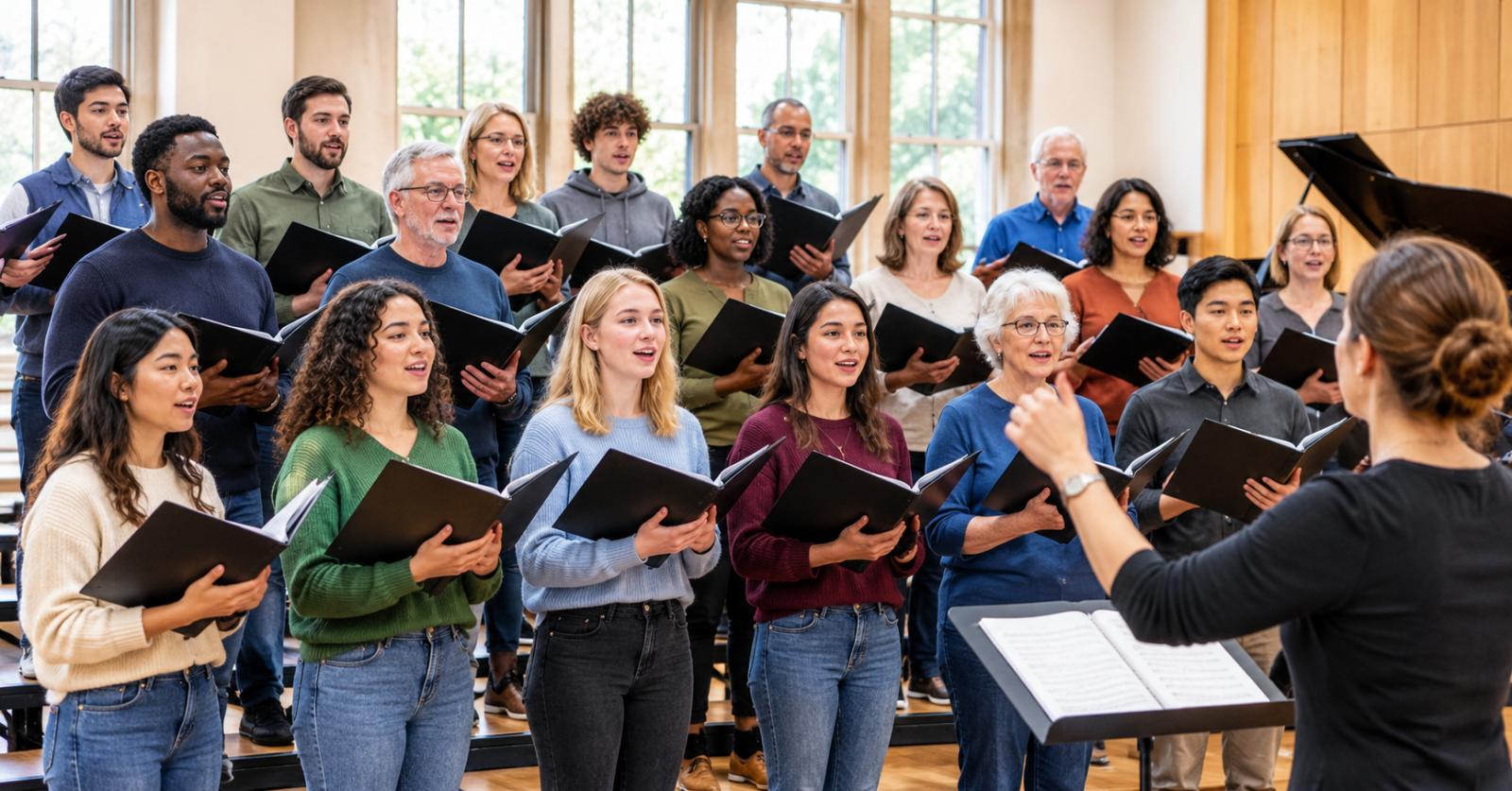
In SATB, four sections sing different notes at the same time, building chords and harmony. A choir may have only a few singers on each part, or dozens.
There are two main ways the parts relate to each other:
-
Homophonic writing: All parts move together with the same rhythm, like in a hymn. This is the easiest style to learn.
-
Polyphonic writing: Each part has its own melody and rhythm, and the lines weave around one another, like in a fugue.
A classic example is the four-part chorale. Bach’s chorale settings, of which roughly 400 are known, are standard models of SATB writing.
Arrangers also follow a few habits that keep the sound balanced. The upper three voices usually stay within an octave of their neighbor, and the bass can sit further below the tenor. The parts rarely cross, so the soprano stays above the alto, the alto above the tenor, and the tenor above the bass.
How Is SATB Written on Sheet Music?
Most SATB scores use either short score or open score.
-
Short score: Two staves. Soprano and alto share the treble staff, and tenor and bass share the bass staff. Soprano and tenor stems point up, while alto and bass stems point down.
-
Open score: Four staves, one for each part. The tenor line is usually written in treble clef with a small 8 under the clef, which means it sounds an octave lower than written.
Many pieces are a cappella, which means without instruments. Others include piano or other instruments, and the accompaniment is printed below the voice parts. You may also see SATB divisi, which means one or more parts split into two lines for some passages.
In publisher catalogs, you will often see the word octavo. A choral octavo is a standard small-format score, usually a single piece. So an SATB octavo is simply one four-part mixed-choir piece printed in that format.
What Is the Difference Between SATB and Other Choir Voicings?
SATB is for mixed choirs with four parts. Other voicings suit groups with different voices or different needs.
-
SSA or SSAA: For treble choirs, such as girls’ choirs, women’s choirs, and many school groups. See our sacred treble choir collection.
-
SAB: Soprano, alto, and baritone. It works for mixed groups that have few tenors. See our sacred SAB collection.
-
TTBB: For men’s choirs.
-
Unison or two-part: Helpful for beginners and young singers.
-
SSAATTBB: A larger divisi layout, where each part is split into two.
Because our catalog is organized by choir type, you can start with the voicing your singers can actually cover.
How Do You Know Which SATB Part to Sing?
Your comfortable range decides it, not how high or low you can reach for one note. A good choir director will help you find your part, and a short audition is normal.
To get started:
-
Find your comfortable range. Sing a scale on a vowel and notice where your voice feels easy.
-
Match it to a part. If you are comfortable on high notes, try soprano or tenor. If your voice sits lower and richer, try alto or bass.
-
Listen to your section. The part that blends best is usually the right one.
-
Stay open to change. Voices change with age, training, and health, so many singers move between parts.
Remember that SATB parts are not exact voice types. Many basses in a choir are actually baritones, and a true low bass is rare.
What Are Examples of SATB Music?
SATB is used across many styles. A few examples are:
-
Four-part hymns and Bach chorales
-
Sacred works such as masses, motets, and anthems
-
Folk song and spiritual arrangements
-
Arabic and Middle Eastern choral works arranged for mixed voices
If you want to try Middle Eastern pieces, our guide to Middle Eastern SATB scores recommends starting with Hal Asmar Ellon, Ya Hinna, and Lamma Bada Yatathanna.
How Does SATB Work in Arabic and Middle Eastern Choral Music?
SATB comes from the Western choral tradition, so it is not a traditional feature of Arabic music. We cover this in more detail in our guide, What Does SATB Mean for Arabic and Middle Eastern Choir Singers.
Traditional Arabic music is largely melodic. It is built on a single line shaped by maqam rather than on chords. When arrangers write SATB versions, they take the maqam melody and build four-part harmony around it, while keeping its ornaments and modal character.
That is why singers should learn a few extra things:
Our scores use standard Western notation adapted to include the maqamat, so classically trained singers can read them without learning a new system.
How Can Beginners Learn an SATB Part?
Learning a part is easier when you break it down.
-
Read all four parts first. Seeing how your line fits with the others makes it easier to sing.
-
Learn your line slowly. Use a piano or an app to find your notes.
-
Sing with the other parts. Practice with a recording or a friend.
-
Mark your music. Circle breaths, difficult entrances, and key changes.
-
Listen across the choir. Blend with your section, and tune to the bass.
How Do You Choose the Right SATB Music for Your Choir?
Start with what your singers can do, then widen the choice.
-
Range: Check each part’s range against your choir.
-
Difficulty: Pick pieces that match your rehearsal time.
-
Language: Choose texts your singers can pronounce with support.
-
Accompaniment: Decide between a cappella and piano or instruments.
-
Fit: Match the piece to the event and audience.
Our post on how to choose Middle Eastern repertoire for your choir goes through this process step by step.
Frequently Asked Questions
What does SATB stand for?
SATB stands for soprano, alto, tenor, and bass. These are the four standard voice parts in a mixed choir, from highest to lowest.
Is SATB only for mixed choirs?
SATB is mostly used for mixed choirs, which have both higher and lower voices. Other groups use voicings such as SSA for treble choirs or TTBB for men’s choirs.
What is the highest SATB voice part?
The soprano is the highest voice part. In SATB writing, it generally sings from about middle C up to the G or A above the staff.
Does every SATB piece have four different notes at once?
No. Parts sometimes sing in unison or double each other, and some passages use only one or two parts. Four-part harmony is the general plan, not a rule for every bar.
What does SATB octavo mean?
It means a piece for four-part mixed choir published as a choral octavo, which is a standard small-format score, usually one piece.
Can a small group sing SATB music?
Yes. A quartet with one singer on each part can sing SATB music, and so can a choir of any size. The balance simply changes with the number of singers.
Conclusion
SATB stands for soprano, alto, tenor, and bass, the four voice parts that make up a mixed choir. Each part has its own range and role, and together they build the four-part harmony found in everything from hymns to folk songs. Knowing how the parts are written, how they differ from other voicings, and how to find your own part makes choral music easier to read and sing.
SATB also travels well. Arabic and Middle Eastern songs can be arranged for four voices while keeping their maqam character, which gives choirs a fresh way to broaden their repertoire. We invite choir directors, singers, and music educators to browse Dozan World’s mixed choir sheet music and find a piece that suits their singers.
Browse Dozan World’s Mixed Choir Sheet Music →



Share this page with your family and friends.