You have done the task a hundred times. You could probably do it half asleep. Then your assessor asks for it in writing, and the words suddenly refuse to arrive.
That is normal, and it is rarely a writing problem. Work lives in your hands and your habits. Writing asks you to pull those habits apart and explain them.
This guide shows you how to do that clearly and honestly, without padding the page.
What a Reflective Account Really Is
A reflective account is a written explanation of something you genuinely did at work. Its purpose is to show how you apply your knowledge and skills in your own role.
The word that matters is real. Not the tidy version, and not how the task ought to have gone. If you asked a colleague for advice, hit a problem or changed your plan halfway through, that belongs in there.
Picture a care worker supporting someone who usually manages most of their morning routine alone. One day, they need more help. A weak account says, “I helped the service user get ready.”
A strong one explains how you noticed the change, what you said, how you respected their choices and who you told. That is where competence shows.
The same applies on a building site or in an office. A worker who stops a job over a hazard, or an administrator who queries an odd entry before passing a record on, is showing judgement. That is exactly what assessors look for.
Where Accounts Go Wrong
Three problems come up again and again.
Too much background. Half the page describes the workplace and the team before the learner reaches their own actions. By then, the reader has stopped paying attention.
Too little detail. “I completed the inspection and reported the problem” leaves everything open. What was inspected? What was wrong? Why did it need reporting?
Hiding behind “we”. It is natural at work, but on paper it makes your contribution disappear. Say what you did.
If a supervisor made the final decision, say what information you gave and what you were asked to do. Honest boundaries read far better than inflated responsibility.
Match Your Work to the Criteria
Most learners have no trouble remembering what happened. The struggle is linking it to the exact wording of the unit. Many people who go looking for Help with NVQ Coursework have plenty of workplace experience. What they lack is a way to connect it to what the criteria actually ask for.
Start with the verb. “Describe”, “explain” and “evaluate” are three different jobs.
Describe means what happened. Explain means why you did it. Evaluate means how well it worked and what you would change.
The fix is not fancier language. It is choosing the part of your experience that genuinely proves the skill.
Following a Procedure Is Not the Same as Understanding Your Responsibility
This is the distinction many accounts miss, and it is often what separates a pass from a request to resubmit.
You can follow every step of a procedure correctly and still not show competence. Assessors also want to see that you understand where your role starts and stops.
Take a care worker helping someone to dress who notices a patch of skin that looks different from the day before. Assessing it is not their job. The right response is to stop, make sure the person is comfortable, and report it to the appropriate colleague in line with the workplace procedure.
In your account, don’t just write “I reported it.” Explain what you noticed, why it was not yours to judge, who you told, how you recorded it and what happened next. Knowing when to stop is a skill, not a failure to finish the task.
The same applies elsewhere. An apprentice electrician who finds something outside their instructions, or a customer adviser asked for a refund above their limit, shows professional judgement by recognising that the decision belongs to someone else.
When you review your draft, ask yourself:
- Did I recognise a point where I needed guidance or authorisation?
- Did I act within my role, and can the reader see where my authority ended?
- Did I pass information on clearly and record it as required?
If the answer to any of these is yes, make sure it is on the page. It is strong evidence of understanding, not just compliance.
The “Because” Test
Here is a simple check that improves almost any account. Read each sentence describing an action and look for a reason.
No reason, no judgement. “I checked the fridge temperatures and reported the problem” is a duty. Add a because, and it becomes evidence.
Before: “I checked the fridge temperatures and reported the problem.”
After: “The log showed a reading outside the range set in our written procedure for that unit. I rechecked with a probe thermometer rather than rely on the display alone. I moved the high-risk items to the working fridge, because the procedure required stock not to stay out of range. I told my supervisor straight away, as the decision about the food was theirs to make. I then recorded the reading and my actions.”
The task is the same, but the second version shows checking, responding, escalating and record-keeping. Nothing was exaggerated.
One caution: your temperature limits and actions depend on your equipment and workplace procedure. Use your own, not figures copied from a guide.
Build a Simple Evidence Trail
Once your draft is finished, print it and write each criterion number in the margin beside the sentence that supports it.
Any criterion without a supporting sentence is a gap. A paragraph with no number beside it deserves a second look. It may provide useful context, but if it contributes nothing to the assessment, consider removing it. Equally, one piece of evidence can support more than one criterion, so note them all.
This takes ten minutes and can save weeks of resubmission. It can also show where another form of evidence, such as observation or professional discussion, may suit better. A reflective account supports your assessment. It does not have to prove everything alone.
Do You Need a Reflective Model?
Not necessarily. What? So What? Now What? is a good starting point: the situation, why it mattered and what you would carry forward.
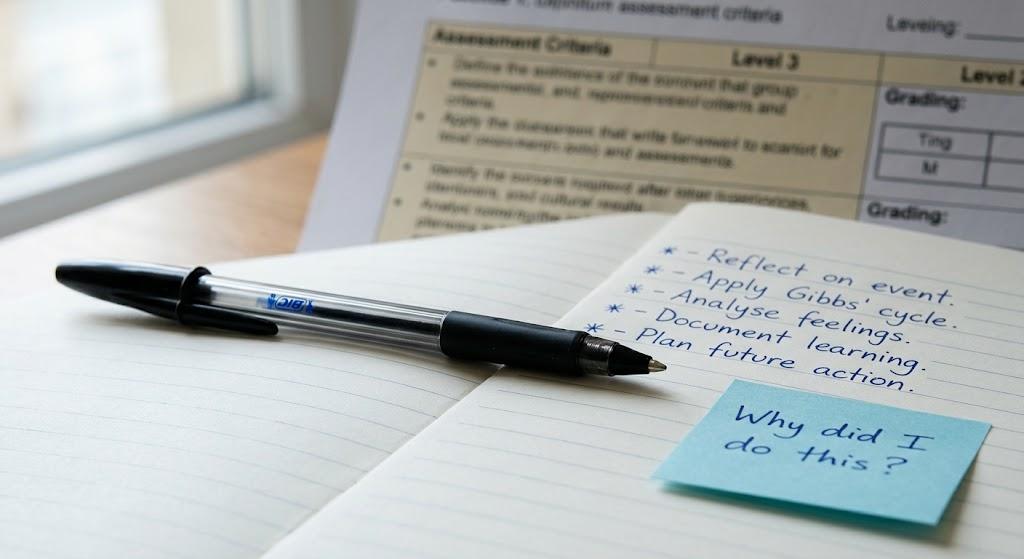
Gibbs’ Reflective Cycle adds feelings, evaluation and analysis. It suits experiences involving uncertainty or a difficult conversation.
Neither is a rigid template, and many NVQs do not require one. Let the criteria lead. A framework organises your thinking; it should never replace evidence.
A Practical Way to Write It
Choose one task you remember clearly that relates to the criteria. Covering several unrelated activities in one account makes it hard to follow.
Jot down notes first:
- What was I responsible for?
- Which procedures or instructions applied?
- Did anything unexpected happen?
- What did I decide, and why?
- What was the outcome, and what would I change?
Then write it plainly. Set the scene briefly, move quickly to your own actions and include the details that show how you worked: a check, a conversation that changed your approach, a concern you raised.
Do not force a lesson into every paragraph. If it went as expected, say what it confirmed about your practice. If it went wrong, say what happened and how you responded.
Mistakes to Avoid
Writing a list of duties. “I checked, prepared and completed” tells nobody about quality.
Making broad claims. “I communicated effectively” means little. Say what you told someone, why, and how you checked they understood.
Using jargon you would never say at work. Use correct occupational terms, but if a sentence sounds impressive and you cannot explain it, rewrite it.
Inventing detail. If your example does not show the skill, choose another or ask your assessor what evidence would suit. Protect confidentiality too: use job roles rather than names, and follow your workplace policy.
Before You Submit
Read it as someone who was not there. Can they follow what happened? Can they tell what you did and what others did? Can they see why you acted as you did, and where your responsibility ended?
If so, the account is doing its job. You are not making an ordinary task sound extraordinary. You are bringing out the competence hidden inside an ordinary working day.




Share this page with your family and friends.