Your data is collected. Your graphs are done. The draft runs to several pages, and still it reads flat.
Many students reach this point. The work looks finished, but something is missing, and it is rarely more research.
Usually the missing piece is interpretation. You have shown the reader what you found. You have not yet shown them what it means.
The good news is that you can fix this using the evidence you already have.
Description and analysis are not the same thing
Take a simple experiment on light intensity and plant growth. A descriptive paragraph says plants under brighter light grew taller, quotes the figures and points to the graph.
That is a fair start. It is not analysis.
Analysis asks why the pattern appeared, how consistent it was and whether every plant followed it. It treats a result as a clue, not a finished answer.
Description tells the reader what the evidence shows. Analysis explains what can reasonably be understood from it.
Subjects differ, of course. A chemistry write-up, a geography fieldwork report and a literary essay all use evidence in their own way. The principle holds everywhere: every claim needs support, and the reasoning between claim and evidence must be visible.
Why good research still produces flat writing
The most common cause is treating findings one at a time. Paragraph one covers the first result, paragraph two the second, paragraph three a strange detail. The reader is left to join the dots.
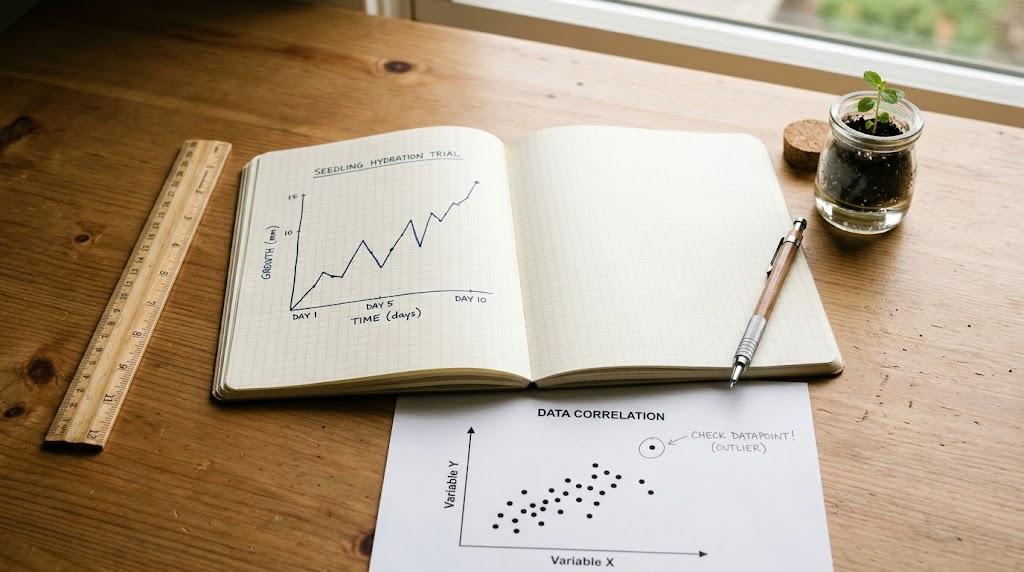
Then comes the awkward result. One group of plants barely changed. It is tempting to label it an anomaly and move on.
Resist that, at least until you have looked closer. It deserves a proper look before you set it aside.
Perhaps the starting conditions differed. Perhaps another factor interfered. Perhaps the trend is weaker than your average suggests. You may never know for certain, and that is acceptable. What matters is that you noticed and said so.
Length is not depth either. Restating one result five different ways adds nothing. Three sharp sentences, covering a pattern, a possible reason and a limitation, will beat a page of repetition.
Quality of interpretation beats quantity of research
Before adding anything new, go back to your research question. Side issues are easy to fall for, and they can eat paragraphs without helping your answer.
Ask one question of each point: if this disappeared, would my answer get weaker? If not, keep it short.
If you have searched for an IB Diploma Coursework Service Online UK because your draft feels thin, the useful lesson is the same. Depth comes from how well you interpret the evidence, not how much of it you gather. And the thinking must still be yours.
Evidence quality matters too. Think about how it was collected, how reliable it is and whether it truly supports the claim. Repeated measurements can expose variation that a single average hides.
Three ideas that do the heavy lifting
Patterns show what is happening across your evidence: a rise, a fall, a repeated difference or no clear trend at all. Spotting a pattern gives you a starting point. It does not explain itself.
Relationships show how findings connect. In an urban temperature study, hotter sites might also have less vegetation. That becomes meaningful once you consider surface materials, shade and building density.
But a relationship is not proof of cause. Several influences usually act together.
Limitations mark the edge of what your evidence can establish. A small sample or inconsistent measurements can limit how far the evidence reaches. Stating that openly makes your evaluation more honest, and it tells the reader how much weight your conclusion can bear.
Think of it this way: patterns tell you where to look, relationships help you explain, and limitations stop you claiming too much.
Three quick checks that need no new data
1. The swap test. Imagine replacing your numbers with completely different ones. Analysis tied to your evidence should change when the evidence changes. If your paragraph reads the same with different numbers, it is probably descriptive.
Try it on your strongest paragraph first. The result can be uncomfortable, but it shows you exactly where to rewrite.
2. The “compared to what?” question. Every figure needs a comparison. Taller than what? Hotter than where? A number without a benchmark is just a number.
3. The confidence ladder. Match your wording to your evidence. “Shows” is strong. “Suggests” is moderate. “May indicate” is cautious. “Cannot confirm” is honest. Choosing the right rung is where real judgement becomes visible.
Picture a site that read 2.1°C warmer and had less tree cover, measured on a single afternoon. “Shows that vegetation cools the area” claims too much. “Suggests that tree cover may be linked to the difference” fits the evidence far better. Adding that one afternoon cannot rule out other causes completes the thought.
A four-step routine for every key finding
Work through each important result in turn. Spend longer on the findings that matter most to your research question. This is where an investigation moves from reporting to explaining.
Observe. State precisely what the evidence shows. “There was a significant change” means nothing until you say what changed and how it was measured.
Matter. Explain why it matters. Does it support your question, challenge your expectation or reveal a difference between groups?
Explain. Offer possible reasons using subject knowledge, but separate what the evidence supports from what is merely possible.
Limit. Ask what could have influenced the result, and whether your sample was big enough.
Picture two urban sites, one warmer than the other. Reporting the gap is description. Noticing the warmer site has less tree cover suggests a relationship. Considering building materials, traffic and time of measurement adds depth. Then you admit you did not control those factors, so the conclusion stays cautious.
No new research was needed. Only better questions.
Mistakes worth avoiding
- Treating every finding as equally important. Prioritise by how much each helps answer the question.
- Dismissing unexpected results as errors. Examine them first.
- Claiming causation from association. Let your language match your method.
- Adding sources to look substantial. Extra research only helps if it answers a real question.
- Hiding limitations in a final paragraph. Place them beside the result they affect.
The takeaway
A more analytical investigation does not hold more information. It uses the information it has more thoughtfully.
Spot patterns instead of listing results. Explore relationships without assuming cause. Admit uncertainty without weakening your argument.
Before you submit, read each analytical paragraph and underline three things: the evidence, the interpretation and the link back to your research question. If one is missing, that paragraph is not finished.
Evidence is not there to fill pages. It is there to build an answer.



)


)
Share this page with your family and friends.