Opening another outlet changes the way a business buys. More employees place requests, more suppliers send invoices and more money is committed before the owner sees a monthly report. A purchasing routine that worked for one location can become difficult to manage across several.
Procurement software gives growing businesses a way to organise those decisions. Its value depends on how well it connects the people requesting supplies with the teams approving expenditure, receiving deliveries and handling accounts. For UAE businesses choosing a system, the priority is finding a practical fit for their operations and the people who will use it.
Decide what the business needs to manage
Procurement covers the activities involved in obtaining goods and services, from identifying a need and selecting a supplier to confirming delivery. Software can support different parts of that process, so two products described as procurement platforms may offer quite different capabilities.
A retailer may mainly need repeat stock orders and reliable receiving records. An events company may need to allocate supplier costs to individual bookings. A larger organisation may require formal quotation requests, contract records and approvals across departments.
Write down the decisions that are difficult today. Are orders waiting for approval? Is it hard to compare supplier terms? Does finance spend too much time identifying which project an invoice belongs to? Use those answers to define the features a provider must demonstrate.
Compare suppliers on the full purchasing cost
The lowest unit price does not always produce the lowest cost for the business. Delivery charges, minimum order quantities, payment terms and the time stock spends in storage can all affect the decision.
Imagine a hypothetical retailer choosing between two packaging suppliers. One offers a lower price but requires a much larger order. The other charges more per unit but delivers smaller quantities when needed. The better choice depends on available storage, how quickly the packaging is used and how much cash the owner wants tied up in stock.
Look for a system that lets staff record the relevant terms alongside supplier details and quotations. Ask how it handles different pack sizes, because comparing a box of 50 with a box of 100 can make a seemingly cheaper offer misleading. If the business buys from overseas, check how currencies and additional purchasing costs are recorded.
Understand spending before the invoice arrives
An approved order represents a commitment even when the supplier has not invoiced it yet. Reviewing only paid invoices can leave managers with an incomplete view of what the business has already agreed to spend.
Ask whether a proposed system can show approved orders that remain open, alongside invoiced purchases. For project-based businesses, check whether each order can be assigned to a job or cost centre. That makes it easier to see which activities are using the purchasing budget.
The team also needs a consistent way to close or cancel unused orders. Otherwise, an old commitment may stay on a report long after the business has decided not to proceed. Define who reviews these records and how often.
Choose the right connection with existing systems
Some businesses prefer purchasing within an ERP platform, where inventory and financial records are managed together. Others need a dedicated procurement application connected to their existing accounts or stock system. The decision should reflect the work involved in keeping those records consistent.
Before choosing either approach, ask where supplier and product records are created, which system owns the current information and how changes reach other applications. Check whether the connection is included in the proposal or requires separate development.
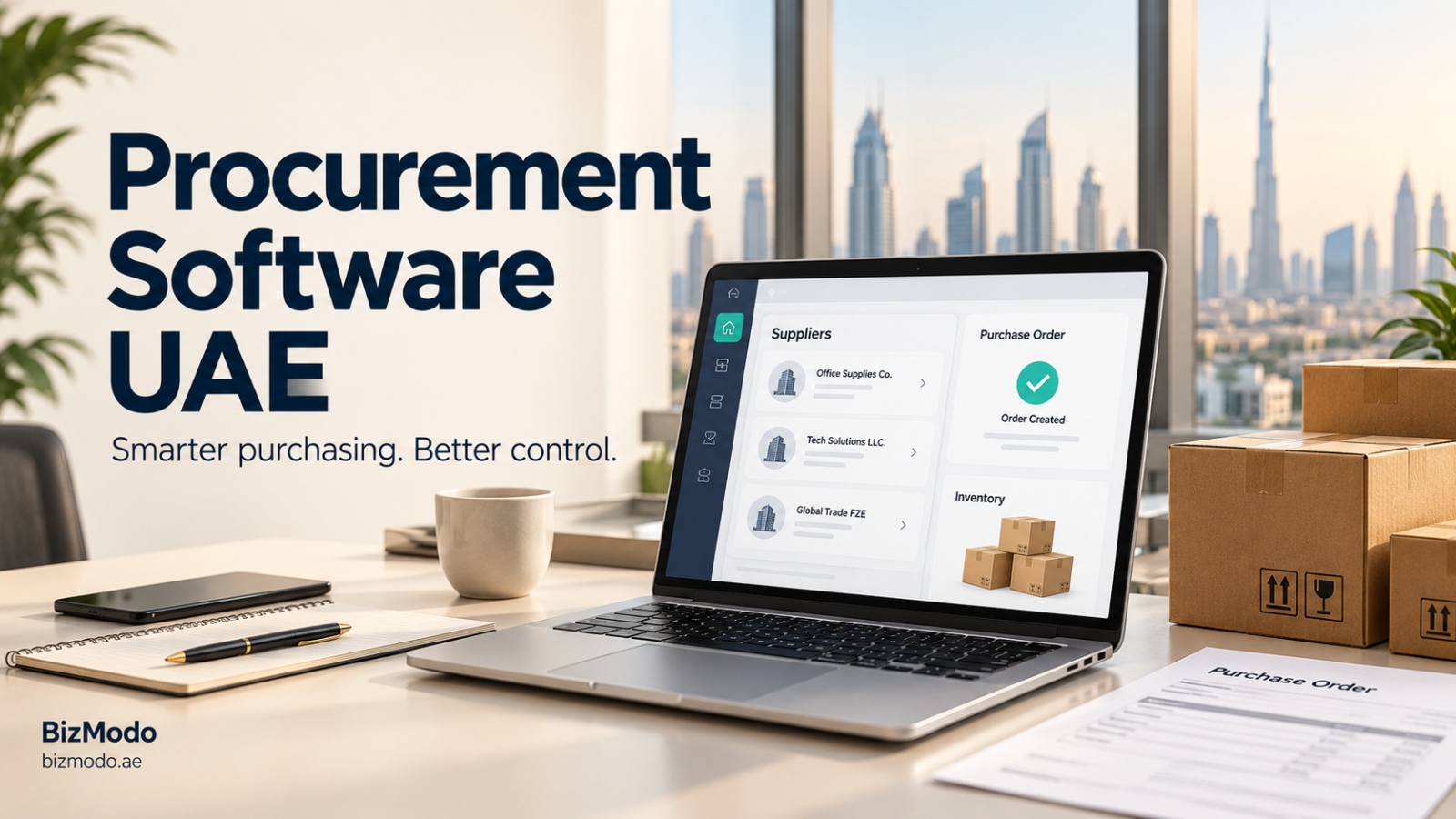
When researching Procurement Software UAE, businesses can explore BizModo’s POS and ERP offering. Its website lists inventory management, supplier order and payment management, financial tools and multi-branch capabilities. Buyers should ask for a demonstration of the purchasing functions relevant to their operations and confirm which are included in their selected plan.
A useful demonstration follows information across the full process. Ask the provider to show what an employee enters, what a manager approves and what finance receives. Any step that requires someone to retype information deserves closer examination.
Make daily use part of the evaluation
A feature only helps when the relevant employee can use it correctly. Include the people who will request goods, receive deliveries and check invoices in the evaluation. Let them attempt ordinary tasks with limited guidance and note where they become unsure.
For a UAE team, consider whether staff need English, Arabic or both. Check the language of documents as well as the interface. If managers approve purchases while travelling between locations, test the actual mobile experience and ask how access is protected.
Also review permissions. An employee may need to create a request without being able to edit supplier payment details. Ask the vendor to demonstrate the roles your business requires, including how access is removed when someone leaves.
Look beyond the monthly subscription
Request a proposal that separates the subscription from implementation, training, data migration and any additional connections. Clarify whether costs change when users, branches or transaction volumes increase.
Support should be equally specific. Find out when assistance is available, how issues are submitted and who helps if a problem affects both the procurement application and an accounting connection. Ask what onboarding covers and whether additional training is charged separately.
Data access matters throughout the relationship. Confirm that supplier records, purchase history and supporting documents can be exported in usable formats. Seeing an example export is more useful than a general promise that the business owns its data.
Roll out with a measurable goal
Choose one purchasing area for the initial rollout and set a practical objective, such as reducing the time requests wait for approval. Establish the current position before the team starts using the new system so later comparisons have meaning.
Prepare the item and supplier records, agree on who maintains them and train the staff involved. During the first few weeks, review incomplete requests and unresolved orders with the team. Their feedback can reveal unclear responsibilities as well as software issues.
The right procurement software should help a growing business make purchasing decisions with better information and less chasing between departments. Choose a provider that can demonstrate your actual requirements, explain the full cost and support a realistic rollout. That gives the business a sound basis for expanding the system as its purchasing needs develop.




Share this page with your family and friends.