Most websites already answer customer questions somewhere, whether on a service page, a blog post or a support section. The problem is that search engines don't always understand which parts of a page are questions and which parts are answers. Structured data fixes that, and FAQ schema is one of the simplest forms of it to add.
If you don't write code, you don't need a developer to get started. A free FAQ schema generator lets you type in your questions and answers and produces clean markup you can paste into your page. At Gold Flex Marketing, we've seen how small technical improvements like this help a page communicate more clearly with search engines, and this one takes about ten minutes.
What Is FAQ Schema and Why Does It Matter?
Schema markup is a standard vocabulary, maintained at Schema.org, that you add to your page's code so search engines can read it more precisely. FAQ schema, specifically, labels a set of questions and their answers so a crawler knows exactly what each block of text means.
Without markup, a crawler has to guess. It reads your headings and paragraphs and tries to work out the structure. With markup, you remove the guesswork and state it directly: this is a question, and this is its answer. Clear signals tend to lead to better interpretation, and better interpretation is the foundation of search visibility.
How a Free FAQ Schema Generator Works
Writing schema by hand means working with JSON-LD, a format that's easy to break with a single missing comma or bracket. A generator handles the formatting for you.
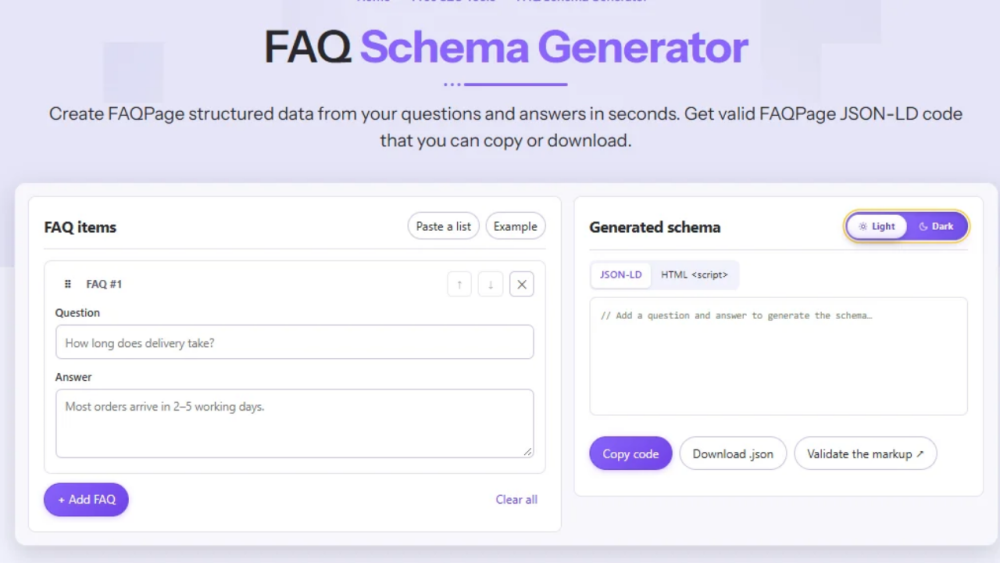
The process is straightforward. You enter each question and its answer into simple fields. The tool builds the structured code in the correct format. You copy the result and paste it into your page's HTML, or into a plugin field if you use a content management system like WordPress. Done properly, the questions in your markup match the questions visible on the page, which is a requirement for the markup to be valid.
Because the tool is free, it also removes the cost barrier. Small businesses and solo marketers can add the same technical polish that larger companies pay for.
Ways FAQ Schema Supports Search Visibility
Here is where a free FAQ schema generator earns its place in your workflow.
Clearer understanding of your content. When search engines can parse your page accurately, they can match it to the right searches. A page with well-marked questions is easier to categorize than a wall of text.
Better alignment with question-style searches. People increasingly search in full questions, especially on mobile and through voice assistants. Content built around real questions, with direct answers, fits that behavior naturally.
Stronger fit for AI-driven search. AI answer engines and assistants look for concise, well-structured answers they can pull from. Structured question-and-answer content is easier for those systems to read and summarize, which can increase the chance your page is used as a source.
A better experience for visitors. The best FAQ sections save people time. When a visitor finds an answer without contacting you, they stay longer and trust you more. Those experience signals support everything else you do in SEO.
An Honest Look at Rich Results
You may have heard that FAQ schema gives you expandable question dropdowns directly in Google results. That used to be true for most sites, but in 2023 Google limited those FAQ rich results to well-known government and health websites. For most businesses, the dropdowns no longer appear in Google's standard results.
That doesn't make FAQ schema pointless. The markup still helps search engines understand your page, other search engines and tools may treat it differently, and the structured Q&A content remains useful for AI-driven discovery. Think of it as clean housekeeping that supports visibility, not a guaranteed shortcut to a special result format. Setting that expectation honestly will serve you better than chasing a feature that may not show up.
Step-by-Step: Adding FAQ Schema to Your Website
Follow these steps for a smooth setup.
- Choose the right page. Pick a service page, product page or blog post where questions naturally belong.
- Write real questions. Use the questions customers actually ask, taken from emails, calls, reviews and search suggestions.
- Write clear answers. Keep each answer helpful and direct, usually two to four sentences.
- Generate the markup. Enter your content into the generator and copy the code it produces.
- Add it to your page. Paste the code into the page's HTML or into your SEO plugin's custom schema area.
- Make sure the content is visible. The same questions and answers must appear on the page itself, not only in the code.
- Test and monitor. Run the page through Google's Rich Results Test or the Schema Markup Validator to catch errors, then check Search Console over the following weeks.
Best Practices for Writing FAQ Content
The markup only works as well as the content behind it. A few habits make a real difference.
Use natural language. Write questions the way a person would say them out loud. "How long does a website redesign take?" works better than "Website redesign timeline information."
Answer first, then expand. Lead with the direct answer so both readers and search engines get the point immediately.
Stay specific to the page. A page about SEO audits should have questions about SEO audits, not a general list that could sit anywhere on your site.
Keep it honest. Don't stuff answers with promotional language or repeat the same keyword over and over. Search engines can spot that, and readers certainly can.
Update regularly. Prices change, processes evolve and new questions come up. Revisit your FAQs every few months so they stay accurate.
Common Mistakes to Avoid
Even with a good tool, a few errors come up again and again.
The first is marking up content that isn't on the page. Search guidelines require the schema to reflect visible content, and hidden markup can cause problems.
The second is using FAQ schema for advertising. Questions that are really sales pitches don't help users and go against the purpose of the markup.
The third is duplicating the same FAQ block across dozens of pages. Each page should carry questions that fit its own topic.
The fourth is forgetting to test. A tiny syntax error can make the whole block invalid, so always validate before you publish.
How Gold Flex Marketing Can Help
Schema markup is one piece of a larger SEO picture. Gold Flex Marketing is a digital marketing agency that helps businesses improve their search presence through technical SEO, content strategy and website optimization. Our free SEO tools exist so anyone can handle simple tasks on their own. When your needs grow beyond that, our team can audit your site, build a structured data plan and make sure every page is working toward your goals.
Conclusion
FAQ schema is a small change with a sensible purpose: it helps search engines and AI systems understand the questions your content answers. A free FAQ schema generator makes that change accessible to anyone, with no coding knowledge and no cost. While the expandable results in Google are now limited to a few types of sites, clear structure, real answers and clean markup still support better understanding and a better user experience.
Start with one important page, write honest answers to real customer questions, generate and test your markup, and build from there. If you'd like expert help turning technical details like this into steady growth, Gold Flex Marketing is ready to support you.
Frequently Asked Questions
What is a free FAQ schema generator?
It's an online tool that turns your questions and answers into structured data code, so you can add FAQ markup to your page without writing the code yourself.
Does FAQ schema improve rankings directly?
Not directly. It helps search engines understand your content more clearly, which supports visibility, but it isn't a guaranteed ranking factor on its own.
Will my FAQs show up as dropdowns in Google results?
For most sites, no. Google now limits FAQ rich results mainly to well-known government and health websites, though the markup can still be useful for understanding and other platforms.
Where do I put the generated schema code?
Paste it into your page's HTML, usually in the head or body, or into the custom schema field of your SEO plugin.
How many questions should I include?
Quality matters more than quantity. Three to eight relevant, well-answered questions per page is a good range.
Can I use FAQ schema on every page?
Only where the page genuinely has a question-and-answer section. Adding it to pages without visible FAQs goes against search guidelines.
How do I check that my schema is valid?
Use Google's Rich Results Test or the Schema Markup Validator, and monitor Search Console for any reported issues.




Share this page with your family and friends.