Ask a surgeon what's actually in their hand the most during a case, and a scalpel usually isn't it. Most say the needle driver. It's there for every stitch — the first deep layer, the last stitch in the skin, everything in between. Let it twist the needle, let it slip even once, or let it wear your hand out three hours into a long case, and you'll feel it. The patient might too, just quietly, in a scar that isn't as neat as it could've been.
This runs through the main patterns of surgical needle holders, what each one's actually good for, and what to look at before buying.
What a Decent Needle Holder Needs to Do
Really just one job — hold a curved needle at the angle you've set, firmly enough that it traces a clean arc through tissue. Three things decide whether it manages that.
The jaws need real texture, enough grip to hold the needle without flattening or bending it. The ratchet has to lock with a crisp click and let go cleanly — a sticky one throws your whole rhythm off mid-stitch. Length and weight matter too, matched to the wound's depth and the needle's size, not just whichever one's sitting closest on the tray.
The Common Patterns, and Where Each Earns Its Place
Mayo-Hegar. The everyday workhorse that ends up on most trays. Sturdy jaws, handles medium to large needles across fascia, muscle, skin. One style to stock if you're only stocking one — start here.
Olsen-Hegar. Scissors built right in behind the jaws, so suturing and cutting happen without swapping tools mid-procedure. Shows up a lot in minor procedures, emergency departments, veterinary work — anywhere closures often happen without a second pair of hands. Watch yourself, though. It's remarkably easy to snip a suture you meant to leave alone.
Crile-Wood. Jaws narrower and lighter than the Mayo-Hegar's. Works well on smaller needles, more delicate tissue.
Baumgartner. Compact build, short and strong jaws. Good with fine to medium needles, solid control in cramped spaces.
Ryder. Slim, tapered jaws made for very fine needles. Turns up often in plastic and vascular trays, wherever small sutures and exact placement actually matter.
Heaney and Sarot. Both built for deep work. Heaney's curved jaws handle the awkward angles pelvic surgery throws at you. Sarot's a longer instrument, meant for suturing deep in thoracic and other hard-to-reach cavities.
Tungsten Carbide or Standard Jaws?
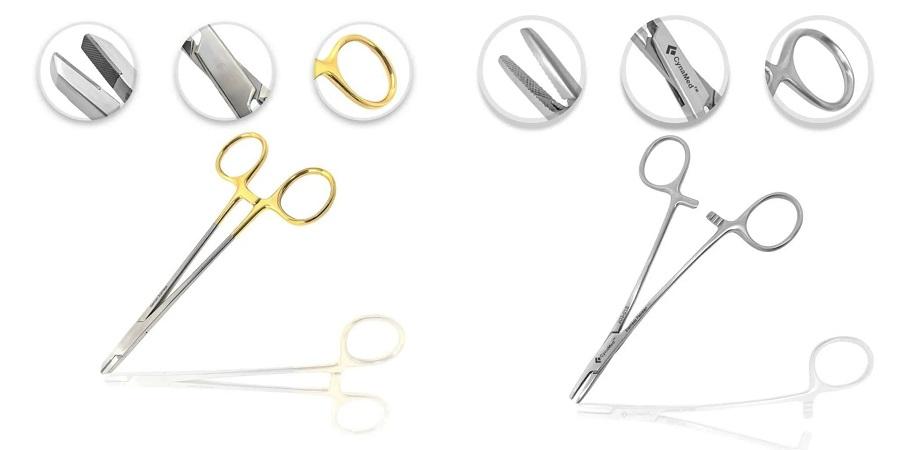
This choice probably matters more for longevity than anything else here. Standard stainless steel jaws with cross-serrations grip well out of the box, but the serrations wear down eventually — that's just physics. Tungsten carbide (TC) inserts run harder, hold their edge much longer, and when they finally do wear out, a decent repair shop can usually just replace the inserts. Gold-coloured ring handles mark most TC pieces, so spotting them on a busy tray takes no effort at all.
High-volume theatres usually find TC worth the small extra cost. Teaching labs, student kits, occasional minor work — standard O.R.-grade does the job just fine there.
Before You Buy
● Close the jaws, hold them to the light — no gaps should show along the tips
● Run the ratchet through every click; each one should feel firm, not mushy
● Pick a length that matches the deepest wound you actually close day to day
● Match jaw fineness to needle size — a heavy driver bends a small needle without even trying
Looking After Them
Rinse right after use, scrub the serrations with something soft while they're still fresh. Ultrasonic bath before sterilizing, every time. Lubricate the box lock regularly, and store them unlocked — leaving one sitting on the ratchet quietly wears down the spring tension over time.
Why Cynamed
Cynamed carries Mayo-Hegar, Olsen-Hegar, Crile-Wood, Baumgartner, Heaney, Ryder, and Sarot patterns, in both TC and O.R.-grade stainless steel, with most models landing between $10 and $20. Building a full set of surgical needle holders stays genuinely affordable at that range.
Final Thoughts
The best needle driver is the one that disappears from your thoughts mid-procedure. Match pattern to tissue, size to needle, and take care of the jaws. Get that right, and every closure feels a little more controlled — which, somewhere around hour eight of a long day, matters just as much as anything else sitting on the tray.




Share this page with your family and friends.